

 한국어
 English
 简体中文
 繁體中文
 日本語
 Монгол
 Русский
 ไทย
 Indonesia
 Tiếng Việt
 العربية
ELASTY Thread Lift
ELASTY is a barbed (cog) thread made by DONGBANG MEDICAL. It comes in two materials that dissolve at different rates (PDO and PCL) and in several products with different barb shapes.
- Manufacturer
- DONGBANG MEDICAL
- Material
- PDO (FORTE Double · FIX), PCL (FORTE Single)
- Thread shape
- Bidirectional barbed (cog) thread
- Procedure time
- About 30 minutes
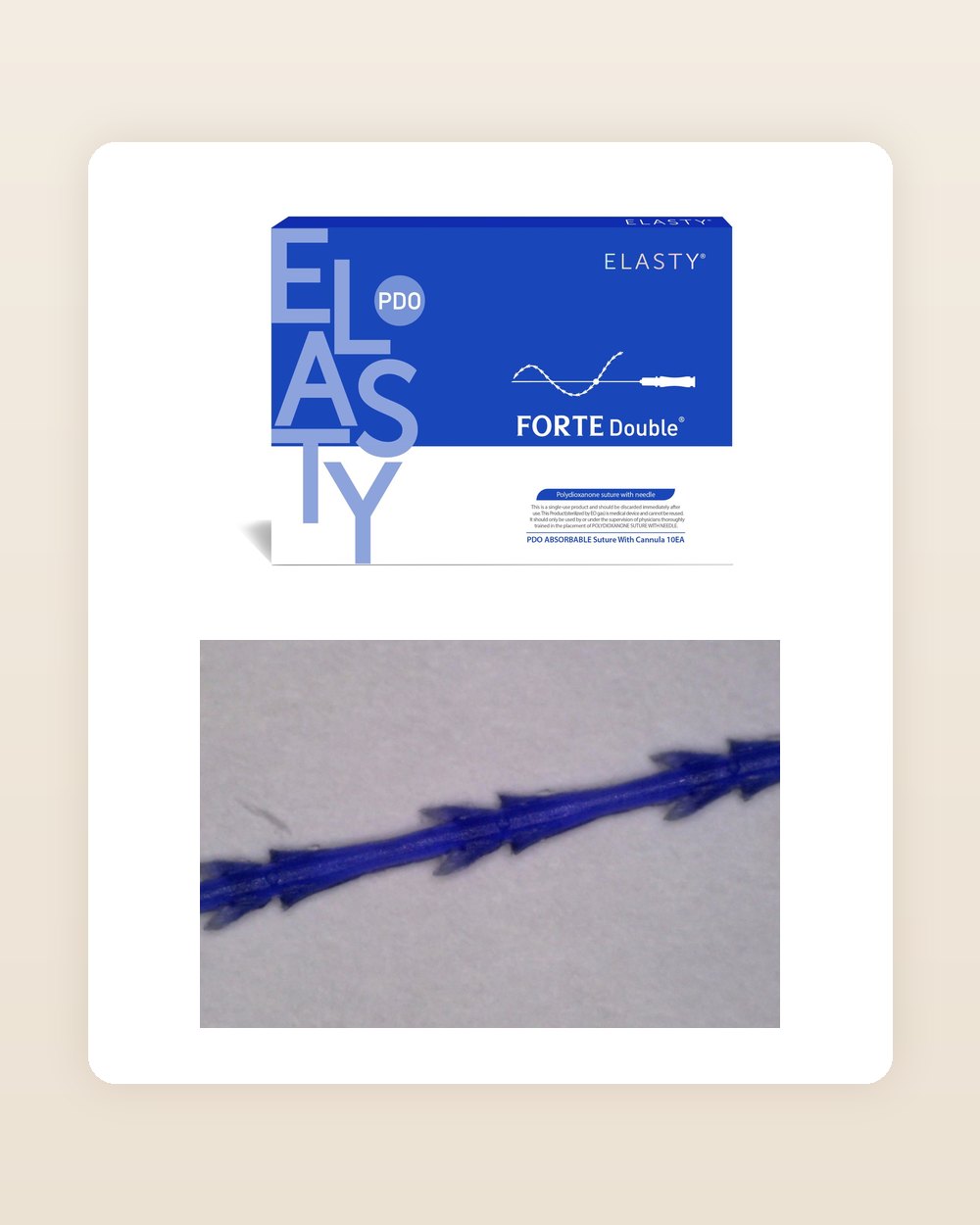
Table of contents for this page
What Kind of Thread Is ELASTY?
ELASTY is a thread made by DONGBANG MEDICAL. Face Plus uses three types: FORTE Double, FORTE FIX, and FORTE Single.
FORTE Double and FORTE FIX are made of PDO (polydioxanone), and FORTE Single is made of PCL (polycaprolactone). Both are dissolvable materials that are absorbed by the body over time, and PCL dissolves more slowly than PDO.
In all three products, the thread comes loaded in a cannula (a thin tube with a blunt tip), and the barbs on the thread grip the tissue.


Thread Lift on Video

ELASTY Product Range
| Product | Material | Thread shape | Areas suggested by the manufacturer |
|---|---|---|---|
| FORTE Double | PDO | A thread with two layers of barbs facing both directions. The front barbs are arrow-shaped and the rear barbs are rake-shaped. | Nasolabial folds and sagging around the mouth (midface), sides of the cheeks, cheekbones |
| FORTE FIX | PDO | A fixation thread with butterfly-shaped barbs alternating with rounded barbs above and below. It is inserted with the tissue already lifted, to fix it in place. | Forehead and eyebrows, jawline (mid and lower face), areas that need fixation |
| FORTE Single | PCL | A thread with a single row of barbs facing both directions | The doctor decides after looking at the condition of your face |
The manufacturer also suggests using FORTE FIX and FORTE Double together. The doctor decides which product to use and how many threads after looking at the condition of your face.

ELASTY Thread Lift: Who We Recommend a Consultation For
- If the area around your nasolabial folds and mouth looks saggy
- If your cheeks and jawline have sagged and your facial contour has become less defined
- If your forehead and eyebrows have drooped
- If you are looking into a way to lift sagging tissue without an incision
Whether a thread lift or surgery is right for you, depending on the degree of sagging, is explained in Lifting Overview.
How Does Face Plus Use ELASTY?
Which thread to use is not chosen by the patient; the doctor decides after looking at the condition of your face. Depending on the degree of sagging, skin thickness, and the area, ELASTY is used on its own or together with other threads.
The basic approach at Face Plus is the reverse technique, in which threads are inserted toward the temple scalp rather than the cheek. Rather than pulling in one direction, we divide the lift across several directions, and the number of threads is decided according to the degree and location of the sagging.
Dr. Park Jung Keun personally handles everything from design to procedure. Details of the method are in Thread Lift Overview.
ELASTY Procedure Information
About 30 minutes
Local anesthesia; sedation if you wish
Not required
Take the antibiotic and anti-inflammatory medication for 3 days
Possible from the day after the procedure
What Precautions Apply After the ELASTY Procedure?
For about 2 weeks after the procedure, please follow the points below.
- It is best to avoid opening your mouth wide or biting down hard.
- It is best to avoid rubbing or pressing on the treated area.
- It is best to avoid sleeping face down.
- It is best to avoid strenuous exercise for 2 weeks.
- It is best to refrain from drinking alcohol for about 2 weeks.
The areas where the threads were inserted are on the side with hair, so tape does not stick well. For that reason, we prescribe an ointment and instruct you to apply it to those areas.
What Side Effects Can ELASTY Have?
After the procedure, temporary swelling, bruising, pain or a pulling sensation may appear, and most of these improve over time.
Depending on the person, symptoms such as skin dimpling, asymmetry or infection may occur, so it is important to consult thoroughly with an experienced medical team before the procedure.
Do not wait in these cases
The changes below are ones you should tell the clinic (02-541-8500) about without waiting until your next visit.
- When pain keeps getting worse over several days
- When one side becomes red and swollen or you have a fever
- When a hard lump can still be felt
- When a thread shows through the skin or its end sticks out
Frequently Asked Questions
How Long Do ELASTY Results Last?
How long a thread lift lasts depends on the type of thread used, the procedure method and your skin condition. In general, the effect can last from 6 months to over 1 year, and a procedure tailored to you along with consistent skin care helps.
What Is the Difference Between PDO and PCL Threads?
PDO and PCL are both dissolvable materials that are absorbed by the body. PCL dissolves more slowly than PDO. The doctor decides which material to use after looking at the area, the degree of sagging, and skin thickness.
I Can Feel the Threads. Is That a Side Effect?
In the early period after the procedure, you may feel the threads along their path or a pulling sensation, and in most cases this gradually eases over time. However, if a thread protrudes through the skin or pain or swelling persists, it is best to see the medical team.
Are There People Who Should Not Have a Thread Lift?
Depending on your skin and general health, the procedure may not be suitable. If there is an infection or inflammation in the treatment area, or if you have a high risk of bleeding or certain medical conditions, a prior consultation is needed. It is important to plan a procedure that fits your condition through a thorough consultation.

He personally consults on and performs facial aging treatments such as facelift, droopy eyelid surgery, and thread lift. The doctor personally sees you from consultation through recovery.
About the DoctorThe content of this page is general medical information provided in accordance with the Medical Service Act, and the effects and recovery time of surgeries and procedures may vary by individual. All surgeries and procedures can cause side effects, so please make your decision only after a thorough consultation with a plastic surgery specialist.