
 한국어
 English
 简体中文
 繁體中文
 日本語
 Монгол
 Русский
 ไทย
 Indonesia
 Tiếng Việt
 العربية
Four effects you can expect from square jaw surgery

- A slimmer overall face line
- Improving asymmetry with attention to left-right balance
- Improved image
- Jawline correction

A square jaw does not go away just because a lot is shaved off
Square jaw surgery cuts away the angular, outward-flaring bone at the corner of the lower jaw to reduce the width of the lower face.

First, we will show you the basic information.
General anesthesia (administered by an anesthesiology and pain medicine specialist)
1 hour to 1 hour 30 minutes
You stay in the hospital for a day
8 hours (not even water)
Usually possible to some extent 1 to 2 weeks after surgery
Recommended from 3–4 weeks before surgery (literature recommendation)
Square jaw surgery cuts away the corner of the lower jawbone in a curve and, if needed, thins the outer bone on the side of the jaw to refine the jawline.
In a word, it is surgery that looks at and refines both the angle of the jaw corner seen from the side and the width of the jaw seen from the front.
The width of the lower face seen from the front is determined by how far the corners of the jaw flare outward. The angular look seen from the side is determined by how sharply the corner bends.
If the parts that bother you differed between your front photo and your profile photo, this difference is the reason.
The skeletal factors in a square jaw are the prominence of the mandibular angle (the corner of the lower jawbone) and the width of the lateral mandibular body (the side of the jaw). Mandibular angle resection cuts the corner in a curve to reduce the angle in the profile, and lateral cortex resection (thinning away the outer bone plate on the side of the jaw) reduces the width from the front. Because it has been pointed out that cutting away only the corner changes the profile but makes only a small change in the width seen from the front, a method is used in which the extent of resection is widened to the side of the jaw and the outer bone plate is removed as well.
In plain terms — The angle seen from the side is reduced by cutting the corner in a curve, and the width seen from the front is reduced by thinning away the outer bone on the side of the jaw. If only the corner is cut, the difference from the front may be small, so the side of the jaw is sometimes refined together with it.

| Conventional square jaw surgery | Face Plus square jaw surgery | |
|---|---|---|
| Surgical method | Resection of the mandibular angle below the ear | Long curved resection from the mandibular angle to the front of the jaw |
| Surgical effect | Effective from the side but limited effect from the front | Effective from both the front and the side |
| Side Effects | A secondary angle may form, or an awkwardly steep jawline may result | A natural, slim jawline without the possibility of a secondary angle |
Long curved resection — Conventional square jaw surgery was a type of surgery that resected only the mandibular angle below the ear. If the mandibular angle below the ear was resected excessively, an awkward line of the commonly known "second angle" shape would form, and the drawback was that the effect from the front could not be seen clearly. Long curved resection cuts in a long curve all the way to the front of the jaw, so it keeps the curved beauty of the existing jawline, and because the resection extends to the front of the jaw, it has the advantage that the effect from the front can also be seen sufficiently.
By what criteria do you choose a clinic? How can you minimize side effects, get a satisfying result, and avoid major problems?
From considering surgery and looking into it with interest to finally deciding to have it, a great deal of deliberation is needed. Even choosing a clinic alone involves too many options. And even after choosing a clinic, various worries arise about side effects, surgical results, and so on.
Seeing the people who visit the clinic for consultations or surgery, I have come to know the concerns that they commonly share. If you were ignored or brushed off after surgery, where could you even go to voice your complaint?
These are, in a way, natural expectations and hopes, but in reality, because we hear stories to the contrary through various channels, it is not easy to feel such confidence. It is good to visit several clinics, gather information, and compare. What is unfortunate is that you gain too much information but get buried in a flood of it, which makes judgment even harder.
Listening to people who have had consultations at several clinics, there are so many who are confused because they have a lot of information and knowledge about surgery but find it hard to judge what is important and what is not. In fact, many of them have consulted doctors who perform the surgery often and do it well, and in most cases what they were told is not very different.
The most important thing is to get a satisfying result while minimizing side effects. It is also to hope that if a problem does arise, it will be resolved smoothly.


It is done when the bone at the corner of the lower jaw is angular and flares outward, so the lower face looks wide and angular.

As you read the list below, picture the jawline in your mirror. If any of it applies, we check at the consultation whether square jaw surgery is right for you.
We do not recommend surgery right away just because something applies. Not every wide jaw is caused by bone. The first of our treatment principles is "We never recommend excessive surgery." If muscle or another cause is the larger factor, we will tell you so.
A Word from the Doctor
"Bone surgery should not be done automatically just because the face looks large and wide; the most important thing is to perform the surgery that is needed after an accurate diagnosis."
If the corner of the jaw rises firmly when you clench your back teeth, the chewing muscles may be larger than the bone.
You can get a rough idea by clenching your back teeth once in front of a mirror. The exact distinction is made by examination, as described below.
At our clinic, we often recommend first reducing the volume with Botox injections rather than surgery that directly cuts away the masseter.
Whether the bone or the muscle is larger is determined by examination and CT (a scan that images the bone in three dimensions). Injections to reduce the muscle are explained in the Botox procedure information.
If the reason the jawline has become blurred is sagging rather than bone, surgery to lift the sagging may come before square jaw surgery.

If you feel that your jawline is not what it used to be, this is something you should be sure to consider before deciding on surgery.
The mandibular angle and the lower border of the mandible (the lower edge of the lower jaw) are the skeleton that supports the soft tissue (skin, fat, and muscle) of the cheeks and jawline. When the bone is cut away, the support is reduced, and the masseter and soft tissue detached from the bone for the resection can settle downward. If skin elasticity has declined, looseness below the jawline or sagging of the cheeks may become more noticeable after surgery.
In plain terms — The jawbone supports the cheek tissue and the jawline. If the bone is reduced, the tissue above it can come down, and the jawline may actually look more blurred. At an age when skin elasticity has declined, this change is easier to see.
That is why, in consultations with middle-aged patients, we look at the degree of sagging of the jawline and neck together with the shape of the jawbone. If the reason the jawline has become blurred is sagging, see the Facelift surgery information and the Neck lift surgery information first; if the area under the chin is loose, see the Double chin muscle tightening surgery information first.
The usual method is to make an incision in the gum outside the lower molars inside the mouth, cut away and refine the bone at the corner of the jaw, and then close the incision with sutures (stitches).
When surgery is done through the inside of the mouth, no scar is left on the outside of the face. In exchange, the bone is cut while viewed through a narrow incision in the mouth, so it is important to confirm the positions of the nerves and blood vessels in advance through planning and CT.
Our clinic's basic method is to cut the bone in a long curve from the corner of the jaw to the side of the jaw toward the front (long curved resection). When the width seen from the front needs to be reduced further, the outer bone plate on the side of the jaw (the lateral cortex) is additionally thinned away. Because of the risks of bleeding and nerve injury, we tend not to cut the chewing muscle (masseter) directly, and if muscle volume remains, we recommend reducing it with Botox. Square jaw surgery only cuts the bone away and does not move it to another place, so no fixation hardware such as metal plates or screws is used.
The anesthesia is general anesthesia, and the operating time is 1 hour to 1 hour 30 minutes. You stay in the hospital for a day after surgery.
Tests for general anesthesia are done before surgery. An anesthesiology and pain medicine specialist administers the anesthesia. You fast for 8 hours before surgery. You may not drink even water.
Since it is your first time, it may feel unclear, so we have laid it out in order below.
Using facial photographs and CT, we look at the shape of the jawbone, left-right differences, and the course of the nerves. Please tell us about all the medications you take and any conditions you have. Even things that seem trivial are fine. Tests for general anesthesia are done before surgery.
An anesthesiology and pain medicine specialist administers general anesthesia. When you wake up, the surgery is already over.
An incision is made in the gum outside the lower molars, and the bone is cut away along the planned line, in a long curve from the corner of the jaw to the side of the jaw toward the front. If the width seen from the front needs to be reduced further, the outer bone plate on the side of the jaw (the lateral cortex) is additionally thinned away.
The edges of the cut bone are smoothed and the bleeding is stopped. Because the bone is not repositioned and fixed, no metal plates or screws are used.
The incision inside the mouth is closed with sutures, and a compression band is wrapped around the face and jaw to reduce swelling and bleeding. You stay in the hospital for a day after surgery.
Face Plus square jaw surgery provides a one-stop medical service from consultation through surgery, recovery, and aftercare, with more accurate and precise diagnosis and surgical planning using a 3D scan before surgery.


When the bone is excessively developed
This is surgery that removes the cortical bone wrapped around the outermost part of the jawbone. It reduces the actual thickness of the bone, which narrows the width of the face. A definite effect from the front can be seen.
When the contour bone is well developed, the bone itself is often thick as well. In this case, cortical bone resection is performed together with long curved resection, reducing not only the size of the bone but also its thickness, which can raise the effect of square jaw surgery. In cortical bone resection, it is important to remove as much cortical bone as possible effectively without touching the line of the nerve.

When the muscle is excessively developed
In some cases, excessively developed muscle makes the face look larger, in addition to causing a square jaw. At our clinic, we do not directly resect the masseter and first recommend reducing the muscle volume with Botox.

When a lot of fat has accumulated
In some cases, the face looks larger because of cheek fat, unneeded fat in the face, or deep buccal fat. When the fat around the jaw is thick and sagging, the jaw looks square. In that case, no matter how much the size and thickness of the bone are reduced by bone resection, it is hard to obtain a satisfying effect even after surgery. When the unneeded fat of the face is removed and the tissue settles snugly against the reduced jawbone, the face looks much smaller and slimmer.
You can usually return to daily life to some extent 1 to 2 weeks after surgery. Swelling lasts longer than that: most of the major swelling goes down during the first month, and the remaining swelling goes down slowly over several months while the jawline settles.
If you have work or an important appointment coming up, this is probably what you most want to know. We have written it by time point.
Swelling is at its worst. Bruising may extend down to the neck
By this time you can usually return to daily life to some extent. While the wound inside the mouth heals, you eat soft food
More than half of the swelling goes down
Most of the swelling has gone down and the jawline is settling
The remaining swelling goes down a little more
The point at which you can return to daily life and the point at which most of the swelling has gone down are different. The speed of recovery differs from person to person, and the jawline immediately after surgery is not the final shape.
After surgery, you will come to the clinic 2 to 3 times over about 2 weeks. The number of visits and the dates are adjusted according to the surgery and your recovery. Once the day for stitch removal is set, please keep that day if at all possible; the other dates can be adjusted.
So that you do not have to endure recovery alone, the doctor and the nursing team check your swelling, pain, and condition together. The third of our treatment principles is “We see patients more frequently after surgery.”
The key is to keep the wound inside your mouth clean and not to put excessive force on your jaw.
Please keep the following five points in mind.
Besides swelling and bruising, bleeding, decreased sensation in the lower lip and chin, left-right asymmetry, unintended fracture of the jawbone, injury to the nerve that moves the corner of the mouth, and jawline sagging can occur. Rarely, the neck can swell and narrow the airway, and there are risks related to general anesthesia.
This is information you need to know before deciding on surgery, so we have written it out in full without shortening it.
This is surgery that cuts away bone. Please make your decision only after fully understanding the items below.
In plain terms — The following three are problems that need treatment right away.
A numb feeling in the lower lip, a left-right difference, a newly formed angle, and jawline sagging become apparent as time passes, and in some cases they are monitored or corrected with another surgery.
For cosmetic purposes, revision surgery is mostly recommended 6 months or more after the operation, but depending on the cause, it is sometimes performed right away.
If you are bothered by the result, we fully understand the wish to fix it as soon as possible. That is why we explain separately the cases in which it should be done quickly and the cases in which it is better to wait.
The timing of revision surgery depends on the cause. In cases like the following, it is better to operate right away without waiting.
Cosmetic revision surgery to refine the shape is mostly recommended 6 months or more after the operation. Before then, swelling remains and the bone and surrounding tissue are still settling into place, so what you see now is not the final shape.
In revision surgery, the dissection (separating the layers from one another) must be performed again through the scar tissue and adhesions (tissues sticking to one another) left from the first operation. Revision surgery to refine a secondary angle is possible, but bone that has already been cut away a lot, or bone that has been reduced to close to the inferior alveolar nerve, is difficult to reduce further and also difficult to restore.
In plain terms — The area that has been operated on once has tissues stuck together, so it is more difficult than the first time. A newly formed angle can be refined, but bone that has been cut away too much is hard to fill back in. That is why we decide the amount to be reduced carefully at the first operation.
A Word from the Doctor
"Simply reducing the bone is not what matters. How much is appropriately left is also very important."
You can call our main number, 02-541-8500, or apply through Consultation & Booking information.
If you still have questions after reading this, please feel free to ask them at your consultation.
The clinic is located on the 4th floor of Vorati Al Building, 480 Gangnam-daero, Gangnam-gu, Seoul. It is a 1-minute walk from Exit 3 of Sinnonhyeon Station.
At your consultation, please tell us about any previous jaw Botox, procedures, or surgery, the medications you take, whether you smoke, and whether you snore or have sleep apnea. If you have a facial CT scan taken previously, you are welcome to bring it.
I want a slimmer face. Do I really have to have square jaw surgery?
— Dr. Park Jung Keun, Plastic Surgery Specialist · Face Plus Talk
He was a male patient in his late twenties. He was concerned that his lower jaw, including a square jaw, was wide overall. He wanted a consultation for square jaw surgery, but he had many worries about bone surgery. Facial contouring surgery is major surgery with a long recovery period, so when it comes to actually doing it, people become frightened and hesitate. This patient felt the same way. He said, "Isn't there a way to get a slimmer face without having facial contouring surgery such as square jaw surgery?"
I told him that of course there is. There are plenty of ways to become slimmer than you are now without going through bone surgery. That is, methods that reduce the rest of the soft tissue other than the bone.
The tissue we call "flesh" includes not only the fat we commonly know of but also muscle and skin. That is, by reducing the volume of fat, skin, and muscle, the face can be made somewhat slimmer. If there is a lot of fat, liposuction of the face can be done; if there is skin sagging, a lifting procedure is needed. Botox may also be used to reduce the volume of the muscle.
In this way, procedures are needed to reduce each component that needs reducing. There are several, but compared with bone surgery they are much simpler and have a shorter recovery period, so they are very effective procedures. In particular, they also have the advantages of no incision in the outer skin and a return to daily life almost immediately.
Of course the result is not permanent like that of square jaw surgery, but if you think of it as ongoing maintenance, the face can be made slimmer with methods that need no recovery period. First, a thorough examination is needed to find out what the excess tissue is and therefore which procedure is needed.
To make the face slimmer, you do not necessarily have to consider bone surgery. There are plenty of techniques that can correct it effectively through various methods. Rather than deciding on facial contouring surgery unconditionally, it is advisable to decide on a specific method after a thorough consultation and examination.
An anesthesiology and pain medicine specialist administers general anesthesia, and when you wake up, the surgery is already over. Tests for general anesthesia are done before surgery, and you fast for 8 hours before surgery, without even water. The operating time is 1 hour to 1 hour 30 minutes, and you stay in the hospital for a day after surgery.
If the cause of the width is the chewing muscles, Botox can reduce the muscle volume. The effect is not permanent. If the cause is bone, injections do not reduce the width of the bone.
You can usually return to daily life to some extent 1 to 2 weeks after surgery. Swelling lasts longer than that: most of the major swelling goes down during the first month, and the remaining swelling goes down over several months.
The usual method is an incision in the gum outside the molars inside the mouth, so no scar is left on the outside of the face.

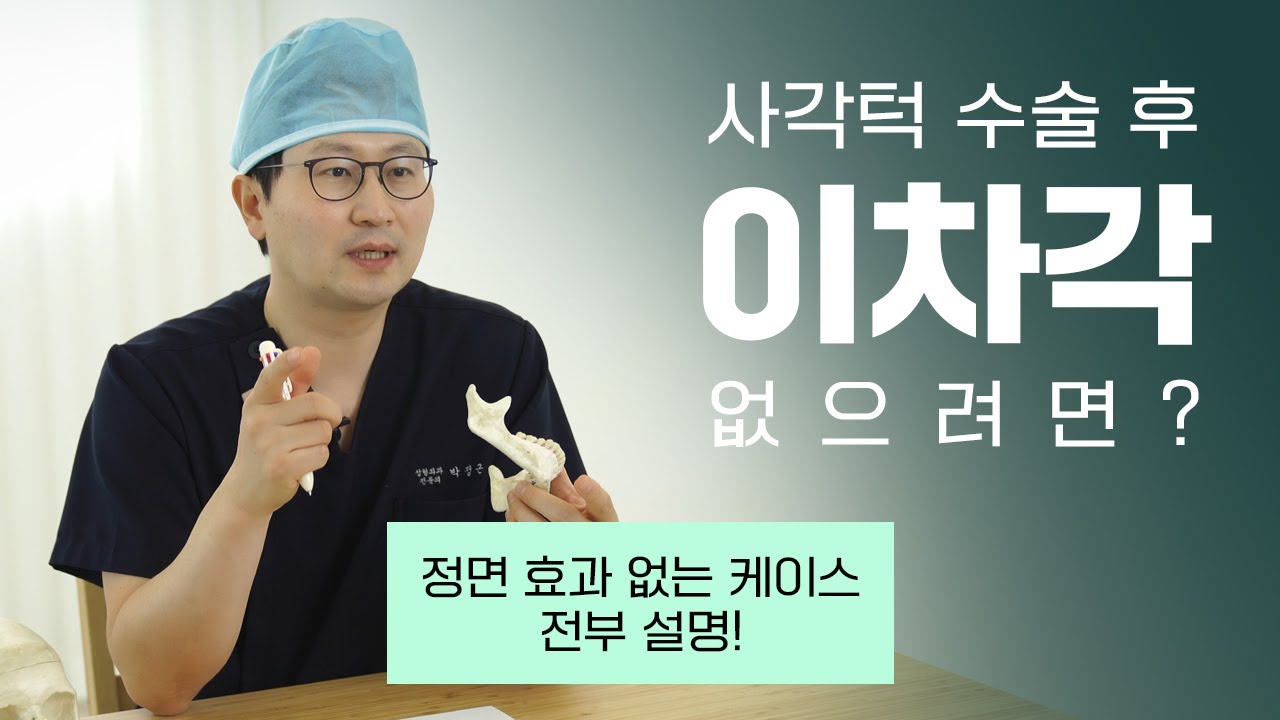
This links to a video on the Face Plus Plastic Surgery YouTube channel. View All FacePlus TV
These are surgeries and procedures often discussed together with this surgery during consultations. Whether to have them together is decided after an examination.

He personally consults on and performs facial aging treatments such as facelift, droopy eyelid surgery, and thread lift. The doctor personally sees you from consultation through recovery.
About the DoctorThe content of this page is general medical information provided in accordance with the Medical Service Act, and the effects and recovery time of surgeries and procedures may vary by individual. All surgeries and procedures can cause side effects, so please make your decision only after a thorough consultation with a plastic surgery specialist.
Facelift, droopy eyelid surgery, and thread lift: Dr. Park Jung Keun personally checks every stage, from consultation to recovery. Please schedule by phone or KakaoTalk, or leave a consultation request form.
Contents of this page: 13 items
 Eye Surgery
 Rhinoplasty
 Fat Grafting