Revision rhinoplasty is even more of a concern than the first surgery: a customized design plan after a precise diagnosis
People considering revision rhinoplasty tend to be more apprehensive and more cautious than they were before their first surgery. Revision rhinoplasty does not necessarily mean removing everything, redoing everything, or needing a large amount of material. Of course, having more material is generally better. However, performing only the surgery that is truly necessary, after a thorough examination and consultation, is also a good approach. As revision methods, we use autologous cartilage, custom implants, and more, and we achieve satisfactory results with a customized revision plan based on an accurate understanding of why the previous surgery failed and the current condition of the nose.
Peace-of-Mind Face Plus Revision Rhinoplasty — Custom Surgical Methods by Cause of Revision
A thorough analysis of why the first surgery failed Face Plus revision rhinoplasty with a personalized design and plan
Accurate analysis of why the previous surgery failed
Revision surgery based on the individual's nasal condition and characteristics
Addressing both functional and aesthetic problems
Personalized design after a precise diagnosis
Minimizing tissue damage and scarring
One-on-one customization with an accurate diagnosis of the nose and analysis of why the previous surgery failed
02
When Revision Rhinoplasty Is Needed — Recommended for People Like These
01
When the implant looks bent
If the implant does not match the shape of the nasal bridge, or the space where the implant was placed was made off to one side, the bridge of the nose can look crooked.
Correction method · After removing the existing implant, we recreate the space for the implant and perform a revision that secures it to the cartilage so that it does not shift out of line.
02
When the implant moves
If the implant was not placed accurately under the periosteum, or if the periosteum was torn during surgery and cannot support the implant, the implant may move.
Correction method · The implant is firmly secured under the periosteum. If the periosteum is damaged, we perform surgery to replace the implant and secure it.
03
Deformity of the nasal tip caused by the implant
If the implant extends all the way to the nasal tip, the pressure can compress and deform the tip cartilage. The skin of the nasal tip may turn red or become thin, so that the implant shows through. In severe cases, the implant may protrude to the outside.
Correction method · After removing the implant and securing it again in the correct position, we reconstruct the deformed cartilage to correct the shape of the nasal tip. Scar tissue removal surgery may also be performed together, as needed.
04
When contracture has developed
If inflammation is left untreated, the inside of the nose can harden and shrink, a condition called contracture. As the contracture worsens, the nose becomes shorter and stiffer, and in some cases the nasal tip is lifted so that the nostrils are visible.
Correction method · After removing the silicone, we perform a corrective surgery that lengthens and lowers the shortened, lifted nasal tip using autologous tissue (nasal septum, ear cartilage, rib cartilage), among others.
05
When the nasal bridge is too high
If an implant is inserted into a wide nasal bridge without an osteotomy, the nose can look larger and the overall impression can look stronger. Likewise, if an implant is inserted without correcting a dorsal hump, the bridge becomes higher and the face can look fierce.
Correction method · For a dorsal hump, after removing the hump, we adjust the height of the implant in consideration of facial balance and then insert it. For a wide nasal bridge, narrowing the bridge with an osteotomy allows the desired bridge line and height to be expected even without inserting an implant.
06
When the nasal bridge is too narrow
In contrast to a wide nasal bridge, an excessively narrow bridge looks artificial and makes the nasal tip look relatively blunt. The ideal width of the nasal bridge is 13 mm for men and 10 mm for women, slightly narrower than the width of the nasal tip.
Correction method · We determine the width of the implant so that the bridge can be widened to suit facial balance, and replace the implant.
07
When the nasal tip has become low
Because the nasal tip is supported only by cartilage and soft tissue, its supporting strength is weaker than that of the nasal bridge. If the tip is raised simply by placing cartilage and an implant on top, over time the tip may become lower and may bend downward.
Correction method · Using the septal cartilage inside the nose, we build a firm support for the nasal tip and then graft the cartilage.
08
When the skin has turned red because of an injectable
When unapproved paraffin or liquid silicone has been used to raise the nasal bridge or nasal tip, over time the nose sinks and spreads flat, the skin becomes uneven, and it turns red and deformed.
Correction method · After removing as much of the inserted foreign material as possible, we correct the damaged skin using autologous dermal fat.
※ For revision rhinoplasty, the surgical method differs for every individual depending on the condition of the nose, so it is important to proceed only after a consultation with a specialist.
03
When to Have Revision Rhinoplasty
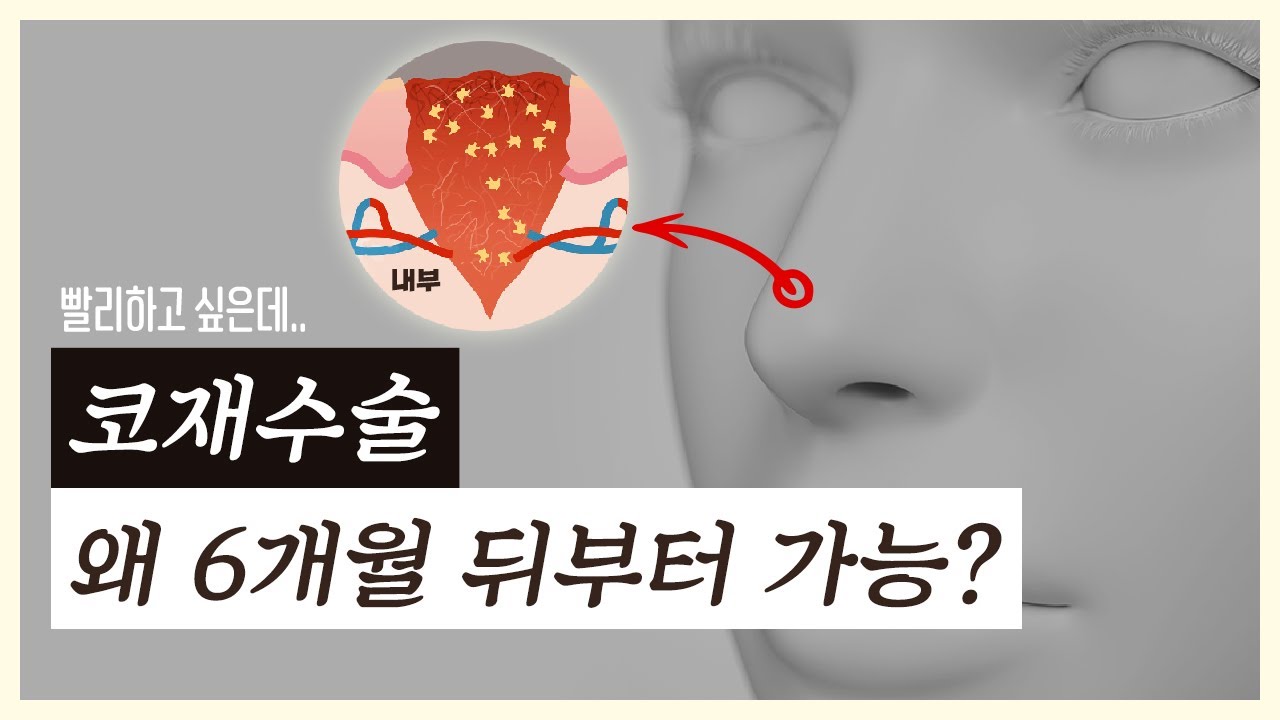
In general, it is advisable to have revision surgery at least 6 months to 1 year after the previous rhinoplasty, when the tissue has become stable and soft overall.
If inflammation caused by silicone is the reason for revision, the removal surgery can be performed right away.
The more times revision rhinoplasty is repeated, the greater the tissue damage, so it is best to discuss with a specialist why revision is necessary and what is required, and then decide on the most suitable correction method.
04
Face Plus Talk
A pimple appeared on my rhinoplasty nose... A case of inflammation 5 years after nose surgery
— Dr. Park Jung Keun, Plastic Surgery Specialist · Face Plus Talk
This patient came to us about 5 years after having nose surgery elsewhere. When a patient was operated on by another doctor, we can often tell roughly which materials were used, but frequently cannot know exactly how the surgery was done. This patient had undergone nose surgery using a silicone implant and septal cartilage.
The patient said that about a year earlier, something like a pimple began to protrude inside the nose. It kept alternating between better and worse, and it had recently become much larger, but the patient said it improved a lot after taking medication. The patient naturally wanted to avoid surgery, but because several possibilities could be involved, I told the patient firmly that we needed to confirm the cause during surgery.
The patient said that apart from the pimple inside the nose, there were no signs of inflammation such as swelling, pain, redness, or warmth. In such cases, the inserted silicone, the septal cartilage, or another structure may be irritating the area and showing up on the outside. If it is due to inflammation, we must open the area in the operating room, clean it thoroughly, and give treatment after surgery to prevent inflammation or infection, while also preventing contracture.
In any case, it is necessary to open the area again and check. Both sides would like to avoid it, but trying to keep resolving a recurring problem with medication alone is not good. It is rather the most reliable and quickest method to open the area, check, and then correct the problem. Letting a problem drag on for a long time is best avoided if it can be avoided.
Fortunately, the patient agreed, and we were able to operate before it was too late. When we opened the area in the operating room, the structures such as the silicone implant and the septal cartilage were well in place, with nothing pushing against or irritating them. However, although there was a slight asymmetry, there were signs of inflammation throughout the area where the implant sat, and this was connected through the weakest part, the mucosa on the inside of the nose.
That is why the pimple inside the nose became severe when the inflammation flared up, and then became smaller when the inflammation subsided, and this kept repeating. Because the inflammation had lasted a long time, the scar tissue was severe and the capsule had become so thick that dissection was difficult. We washed the area out thoroughly, scraped it clean, created a new pocket for the implant, and inserted it again.
What I considered fortunate was that we treated the inflammation before it was too late. If it had been delayed much longer, there might have been changes in shape or other, bigger problems. In fact, for most problems, finding and treating them early usually resolves them without major trouble. As I always say, it is important to see patients more often and more attentively after surgery.
There is no single correct answer for a surgical method. After a thorough consultation, we proceed with a surgical method tailored to each individual. Online Consultation
05
FacePlus TV — Related Videos
Why Is Revision Rhinoplasty So Expensive? Why Is It More Difficult?Keep This in Mind When Choosing a Revision Rhinoplasty Clinic!! | Selection CriteriaSide Effects Seen in Real Revision Rhinoplasty Cases! Plus How to Resolve Them!Why Is Revision Rhinoplasty Only Possible After 6 Months?Why You Should Go to the Clinic Instead of Wondering “Is This a Side Effect?” After Nose SurgeryWhat You Must Know at a Revision Consultation_Frequently Asked Revision QuestionsPoints You Must Check, as Important as Revision Rhinoplasty ReviewsAutologous Tissue or Silicone for Revision Rhinoplasty? | Criteria for Choosing
1 / 8
This links to a video on the Face Plus Plastic Surgery YouTube channel. View All FacePlus TV
06
Precautions
Results of procedures may differ from person to person. They may differ depending on the patient's condition and the surgical method.
The content of this page is general medical information under the Medical Service Act, and the effects and recovery times of surgeries and procedures may differ from person to person. All surgeries and procedures can cause side effects, so please decide only after a thorough consultation with a plastic surgery specialist.
07
Surgeries and procedures worth considering together
These are surgeries and procedures often discussed together with this surgery during consultations. Whether to have them together is decided after an examination.
Dr. Park Jung Keun · Plastic Surgery Specialist, PhD in Medicine
He personally consults on and performs facial aging treatments such as facelift, droopy eyelid surgery, and thread lift. The doctor personally sees you from consultation through recovery.
2004 Plastic Surgery Specialist2013 PhD in Medicine, Seoul National UniversityVice President, Korean Association of Plastic Surgeons
We begin by looking together, through thorough consultation, at whether surgery is needed
Facelift, droopy eyelid surgery, and thread lift: Dr. Park Jung Keun personally checks every stage, from consultation to recovery. Please schedule by phone or KakaoTalk, or leave a consultation request form.


 한국어
 English
 简体中文
 繁體中文
 日本語
 Монгол
 Русский
 ไทย
 Indonesia
 Tiếng Việt
 العربية







 Nasal Tip Surgery
 Thread Lift
 Refill (Lifting + Filler)
