Facial Contouring

Chin Surgery

The best chin surgery should be simple, with a definite effect

Chin surgery corrects a receding, long, or wide chin by moving bone or inserting an implant.

Model photo for the Face Plus Plastic Surgery chin page
Table of contents for this page
  1. What is chin surgery?
  2. When is chin surgery performed?
  3. How does moving the chin bone differ from an implant?
  4. Can chin surgery be done in your 40s and 50s too?
  5. How is chin surgery performed?
  6. How long does recovery from chin surgery take?
  7. How do I get a consultation for chin surgery?
  8. Face Plus Talk
  9. Frequently Asked Questions
  10. Related FacePlus TV Videos
  11. Related surgeries and procedures worth looking at together
  12. References

First, we will show you the basic information.

Chin implant placement and chin bone cutting surgery (osteotomy) are different surgeries. Because they differ from the anesthesia onward, the table below describes the two surgeries separately.

Anesthesia

Implant placement is done under sedation or local anesthesia, and chin bone cutting surgery under general anesthesia (general anesthesia is administered by an anesthesiology and pain medicine specialist)

Incision

Both surgeries are performed only through the inside of the mouth (inside the lower lip)

Stitches

Both surgeries use dissolving sutures, and the stitches are removed inside the mouth after 2 weeks

Surgery time

Chin bone cutting surgery 1 hour to 1 hour 30 minutes / implant placement about 1 hour

Hospital stay

Chin bone cutting surgery may require a hospital stay of about one day depending on the surgery / no hospital stay for implant placement

Fasting before surgery

8 hours for general anesthesia (no water either) / at least 4 hours when implant placement is done under sedation

Daily life

For both surgeries, usually possible to some extent 1–2 weeks after surgery

Quitting smoking before surgery

Recommended from 3–4 weeks before surgery (literature recommendation)

Timing of revision surgery

Depends on the cause. For revision surgery for cosmetic purposes, we mostly recommend waiting until 6 months or more after surgery

Because this is surgery on bone, you may be very worried. Below we explain in order the methods, recovery, side effects, and symptoms to check promptly.

01

What is chin surgery?

Chin surgery changes the length, projection, and width of the chin by cutting the chin bone and moving and fixing it in the desired direction, or by placing an implant in front of the chin bone.

In a word, it is a surgery that changes the shape of the chin by moving the chin bone or placing an implant in front of it.

Chin implant placement and chin bone cutting surgery have similar names but are different surgeries. Both the anesthesia and the extent of surgery differ.

The chin determines the end of the face's profile. So the nose, lips, and jawline all look different along with it.

Mechanism

Chin osteotomy (genioplasty, a surgery that cuts and moves the chin bone) cuts the chin bone horizontally below the roots of the lower front teeth and the mental foramen (the bone opening from which the nerve supplying chin sensation emerges), then moves the cut segment forward, backward, up, or down, or removes the middle segment to reduce the width, and fixes it with a metal plate or screws. Implant placement does not cut the bone; an implant such as silicone is placed in front of the chin bone to bring it forward.

In simple terms — There are two methods of chin surgery.

  • Moving the bone: The chin bone is cut, moved to the desired position, and fixed. Not only forward and backward but also the length and width can be changed. It takes 1 hour to 1 hour 30 minutes under general anesthesia.
  • Implant placement: The bone is left as it is, and an implant is placed in front of the chin. It is mainly used to bring the chin forward. It takes about 1 hour under sedation or local anesthesia.

Face PlusEffect of chin surgery at Face Plus Plastic Surgery — improving the length of a protruding chin, chin reduction surgery

Wide chin, protruding lower jaw, long chin, short chin, receding chin — even from the front, chins come in many types
Face Plus Plastic Surgery's chin surgery gives priority to the characteristics of each individual's chin and to overall balance and harmony

Jawline and neckline of a female model

Results may vary from person to person.

Face PlusChin reduction surgery to improve the length of a protruding chin

For a narrow, long, protruding chin, the long chin length is improved through an incision inside the mouth.

Chin reduction — osteotomy site
Chin reduction — after length improvement

Results may vary from person to person.

Face PlusV-line T-osteotomy to reduce the width and length of the chin

While reducing the length and width of a protruding, long, blunt chin, a V-line effect can be expected.

The chin line is cut in a T shape, avoiding the nerve.
01The chin line is cut in a T shape, avoiding the nerve.
The middle bone fragment that was cut out is removed.
02The middle bone fragment that was cut out is removed.
The two cut sides of the chin are brought together.
03The two cut sides of the chin are brought together.
  1. The jaw bone is brought together without touching the nerve.
  2. The protruding bone at the mandibular angle on both sides is resected, and the bone fragments are removed.
  3. The fixation pins are secured.

Face PlusTo those who are worried about facial contouring surgery...

By what criteria do you choose a clinic? How can you minimize side effects, get a satisfying result, and avoid major problems?

From considering surgery and looking into it with interest to finally deciding to have it, a great deal of deliberation is needed. Even choosing a clinic alone involves too many options. And even after choosing a clinic, various worries arise about side effects, surgical results, and so on.

Seeing the people who visit the clinic for consultations or surgery, I have come to know the concerns that they commonly share. If you were ignored or brushed off after surgery, where could you even go to voice your complaint?

These are, in a way, natural expectations and hopes, but in reality, because we hear stories to the contrary through various channels, it is not easy to feel such confidence. It is good to visit several clinics, gather information, and compare. What is unfortunate is that you gain too much information but get buried in a flood of it, which makes judgment even harder.

Listening to people who have had consultations at several clinics, there are so many who are confused because they have a lot of information and knowledge about surgery but find it hard to judge what is important and what is not. In fact, many of them have consulted doctors who perform the surgery often and do it well, and in most cases what they were told is not very different.

The most important thing is to get a satisfying result while minimizing side effects. It is also to hope that if a problem does arise, it will be resolved smoothly.

Dr. Park Jung Keun writing consultation notes at his desk in the examination room

Face PlusChin surgery suited to the patient's condition — long experience of a plastic surgery specialist dedicated to facial contouring

Simple surgery, definite effect
Face Plus chin surgery

Jawline of a female model with a hand under the chin
  • Improvement of the chin according to its degree, even without double-jaw surgery
  • Surgical planning based on analysis of the facial bone lines, proportions, and shapes
  • A natural line that is not excessive
  • A three-dimensional jawline considered from both the front and the side
02

When is chin surgery performed?

It is performed when the chin is set back (receding chin), long, wide and angular, or crooked to one side.

In the table below, find the concern closest to your chin in the mirror.

ConcernUsual direction of correction
The chin is set back (receding chin)The chin is moved forward, or brought forward with an implant
The chin is longPart of the chin bone is cut out to reduce the length
The chin is shortThe chin bone is moved downward to increase the length
The chin protrudes forwardThe chin is moved backward
The chin is wide and angularThe middle segment is removed to reduce the width
The chin is crooked to one sideThe chin is moved to the center to align it

Having one of these concerns does not mean we recommend surgery right away. The first of our treatment principles is “We never recommend unreasonable surgery.” If a cause other than the chin is greater, we will tell you so.

A Word from the Doctor

“Just because someone has a receding chin, you must never simply put in an implant or only bring the chin forward.”

When the cause of a receding chin is the whole lower jaw rather than the chin

If the lower teeth are set back or protrude considerably relative to the upper teeth, a surgery that changes only the chin may not be enough.

If the way your teeth meet has always bothered you, read this section first.

If the chin is only slightly set back, there are also ways to fill it without surgery. These are explained in Filler procedure information and Fat grafting surgery information. Because the balance of the profile is seen together with the nose, if the nose is your concern, please also see Rhinoplasty surgery information.

Face PlusChin surgery methods by degree of receding chin

Chin Advancement
CASE 1

Chin Advancement

For a severely receding chin

For a severely receding chin, the recessed lower jaw (chin) bone is cut and moved forward. Because the bone itself is moved without an implant, the result looks natural and the change in the neck and side profile is dramatic.

  • General anesthesia
  • Dramatic change in the side profile
  • Permanent effect
Implant Placement
CASE 2

Implant Placement

For a chin that is not severely receding

This is a relatively simple surgical method in which an implant is inserted into the chin through an incision inside the mouth. Because it is done under sedation and local anesthesia, the burden is small, there is almost no swelling, and daily life is possible in 2–3 days.

  • Sedation
  • Quick return to daily life
  • Semi-permanent effect
Mouth line and chin of a female model
CASE 3

Fat grafting / filler

Simple, without an implant

For people who are uncomfortable with implants, volume can be added with autologous fat grafting, fillers, and so on. With fillers, there is almost no bruising or swelling, and daily life is possible right after a simple procedure of about 15 minutes.

  • Daily life possible right after the procedure
  • No concern about implants
  • Natural improvement

Face PlusFacePlus Chin Surgery Is Recommended for People Like These

  • When the chin is severely wide or narrow
  • When the chin looks severely long or short from the side
  • When the chin is blunt or receding
  • When the side profile bothers you because of the chin
  • When the teeth meet normally but the face looks long
03

How does moving the chin bone differ from an implant?

Moving the bone can change the length, width, and direction as well, while an implant is mainly used to bring the chin forward without cutting the bone.

Jawline and neckline of a female model

Since you are probably most curious about which of the two methods suits you, we have placed them side by side in a table.

Moving the chin bone (osteotomy)Implant placement
What can be changedForward/backward position, length (lengthening/shortening), width, left-right crookednessMainly bringing the chin forward
AnesthesiaGeneral anesthesiaSedation or local anesthesia
Surgery time1 hour to 1 hour 30 minutesAbout 1 hour
IncisionInside the mouth, inside the lower lipInside the mouth, inside the lower lip
StitchesDissolving sutures, removed inside the mouth after 2 weeksDissolving sutures, removed inside the mouth after 2 weeks
Daily lifeUsually 1–2 weeks after surgeryUsually 1–2 weeks after surgery
What remains in the bodyMetal plates and screws that fix the boneImplant
Points of cautionReduced mental nerve sensation, bone-healing period, tooth rootsInfection, implant shifting or showing through, bone resorption under the implant

The two surgeries differ from the anesthesia onward. Chin bone cutting surgery takes 1 hour to 1 hour 30 minutes under general anesthesia, and implant placement takes about 1 hour under sedation or local anesthesia. For both surgeries, the incision is made only inside the mouth (inside the lower lip), dissolving sutures are used, and the stitches are removed inside the mouth after 2 weeks. Implant placement does not require a hospital stay, and when done under sedation, you fast for at least 4 hours before surgery.

At our clinic, we also consider an implant if the chin is short and not greatly recessed, and we recommend osteotomy if the chin is long, the width needs to be reduced, or a lot of correction is needed. If the receding chin is very severe, the two methods are sometimes used together.

A Word from the Doctor

“In the case of a very severely receding chin, any single method clearly has its limits.”

04

Can chin surgery be done in your 40s and 50s too?

We do not decide based on age alone, but moving the chin back or reducing it can leave extra skin under the chin that looks loose, so we also look at the condition under the chin.

Profile of a female model with a hand on her neck

Some people worry that it may be too late for chin surgery now. So we begin by explaining what is looked at together.

Mechanism

The chin bone is the front support from which the soft tissues (skin, fat, and muscle) under the chin and in the front of the neck hang. Moving the chin backward or reducing its length shortens this support, so if skin elasticity has declined, the soft tissue under the chin can look loose. Conversely, moving the chin forward pulls the soft tissue under the chin forward.

In simple terms — The chin is the front support on which the flesh under the chin hangs. Reducing the chin or moving it back can make the leftover flesh look loose. Moving the chin forward pulls the area under the chin forward.

If the area under the chin is already loose, chin surgery alone may not be enough. Looseness under the chin is explained in Double chin muscle tightening surgery information.

05

How is chin surgery performed?

The usual method is to incise the gum inside the lower lip, cut and move the chin bone and fix it, or insert an implant, then reattach the muscle and suture (stitch) the incision.

Both surgeries are performed only through an incision inside the mouth (inside the lower lip). Dissolving sutures are used, and the stitches are removed inside the mouth after 2 weeks. Because the surgery is done from inside the mouth, no scar is left on the outside of the face.

Our clinic performs both osteotomy and implant placement; we also consider an implant if the chin is short and not greatly recessed, and we recommend osteotomy if the length needs adjusting, the width needs reducing, or a lot of correction is needed. For osteotomy we mainly use the T-osteotomy method, which allows width, length, and front-back position to be adjusted together, and the moved bone is fixed with small metal plates or fixation pins. For implants, silicone is mainly used.

Anesthesia and surgery time differ between the two surgeries

Chin bone cutting surgery takes 1 hour to 1 hour 30 minutes under general anesthesia, and implant placement takes about 1 hour under sedation or local anesthesia.

Chin bone cutting surgery may require a hospital stay of about one day depending on the surgery / no hospital stay for implant placement.

When general anesthesia is used, tests for general anesthesia are done before surgery. Anesthesia is administered by an anesthesiology and pain medicine specialist. You fast for 8 hours before surgery. No water either.

Since it may feel vague the first time, we have laid it out step by step.

1. Consultation and planning

Using facial photographs and CT (a scan that images bone in 3D), we look at the shape of the chin bone, the positions of the tooth roots and nerves, and how the teeth meet. Please tell us about all the medications you take and any illnesses you have. Before surgery under general anesthesia, tests for general anesthesia are done. Even things that seem trivial are fine.

2. Anesthesia

For chin bone cutting surgery, an anesthesiology and pain medicine specialist administers general anesthesia. When you wake up, the surgery is over. Implant placement is done under sedation or local anesthesia.

3. The inside of the mouth is incised and the chin bone is exposed

The gum inside the lower lip is incised, and the chin muscle is detached from the bone. The place where the nerve for chin sensation emerges is identified and protected.

4. The bone is moved and fixed, or an implant is inserted

The chin bone is cut in a T shape along the planned line, moved, and fixed with small metal plates or fixation pins. When an implant is used, a pocket is made in front of the chin bone and a silicone implant is inserted and secured.

5. The muscle is reattached and the incision is sutured

The detached chin muscle is reattached to its original place, the incision is sutured with dissolving sutures, and tape or a compression band is applied around the chin. The stitches are removed inside the mouth after 2 weeks. Chin bone cutting surgery may require a hospital stay of about one day depending on the surgery / no hospital stay for implant placement.

06

How long does recovery from chin surgery take?

After chin bone cutting surgery, you can usually return to daily life to some extent in 1–2 weeks. Swelling lasts longer than this: the major swelling goes down considerably during the first month, and the remaining swelling subsides slowly over several months. Lower lip sensation may take even longer to return.

If you have work or an important appointment coming up, this is probably what you most want to know. The table below lists the course after chin bone cutting surgery by time point.

Time pointCourse
First few daysSwelling is at its worst. The lower lip and chin feel numb and stiff
1–2 weeksBy this time you can usually return to daily life to some extent. While the wound inside the mouth heals, you eat soft food
2 weeksThe stitches are removed inside the mouth
About 1 monthMore than half of the swelling goes down
Around 6 monthsMost of the swelling has gone down and the shape of the chin begins to settle
Around 1 yearThe remaining swelling goes down a little more

The time when daily life becomes possible and the time when most swelling has resolved are different. The speed of recovery varies from person to person, and the chin right after surgery is not its final shape.

Recovery from chin implant placement

After chin implant placement as well, you can usually return to daily life to some extent in 1–2 weeks. The stitches are removed inside the mouth after 2 weeks.

ItemChin bone cutting surgeryChin implant placement
Surgery time1 hour to 1 hour 30 minutesAbout 1 hour
Daily lifeUsually 1–2 weeks after surgeryUsually 1–2 weeks after surgery
StitchesRemoved inside the mouth after 2 weeksRemoved inside the mouth after 2 weeks

The swelling course table above shows values for chin bone cutting surgery.

After surgery, you will visit the clinic 2–3 times over about 2 weeks. The number and dates of visits are adjusted according to the surgery and your recovery. Dissolving sutures are used for closure, and the stitches are removed inside the mouth after 2 weeks. Please keep the stitch removal day if possible; the other dates can be adjusted.

So that you do not have to endure recovery alone, the doctor and the nursing team check your swelling, pain, and condition together. The third of our treatment principles is “We see patients more frequently after surgery.”

Precautions after surgery

The key is not to move your chin and lower lip excessively until the reattached chin muscle and the wound inside your mouth have healed.

We realize it may be inconvenient, but everything below is meant to help the wound heal well.

  • It is best to avoid turning your lower lip inside out to look at the wound.
  • It is best to avoid pressing on or bumping your chin.
  • It is best to avoid biting off hard or tough food forcefully with your front teeth.
  • After meals, rinse your mouth to keep the wound clean.
  • Smoking slows wound healing and bone union.
07

How do I get a consultation for chin surgery?

You can call our main number, 02-541-8500, or apply through Consultation & Booking information.

If you still have questions after reading this, please feel free to ask them at your consultation.

The clinic is located on the 4th floor of Vorati Al Building, 480 Gangnam-daero, Gangnam-gu, Seoul. It is a 1-minute walk from Exit 3 of Sinnonhyeon Station.

At your consultation, please tell us about any previous chin filler, implant, or surgery, whether you have had orthodontic treatment, the medications you take, and whether you smoke. If you have a facial CT scan taken previously, you are welcome to bring it.

08

Face Plus Talk

Square Jaw Reduction Surgery and Nerve Injury?

— Dr. Park Jung Keun, Plastic Surgery Specialist · Face Plus Talk
Dr. Park Jung Keun

In facial contouring surgery, especially square jaw reduction or chin surgery, particular care must be taken to preserve the nerves. Of course, in most cases nerve injury does not occur. This is because, in most cases, the nerves lie quite far from the site where the bone surgery is performed.

In addition, the position of the nerve can be determined sufficiently well from the X-ray taken before surgery. The nerve position can also be confirmed by eye during surgery in the operating room. So checking the position of the nerve is essential when performing square jaw surgery, but in most cases it does not become a major problem.

Then in what cases does it become a problem? First, if too large an amount is removed, injury may be possible. The bone is not necessarily removed all the way to the nerve position, and that is not desirable either. However, if an excessive amount is removed relative to the course of the nerve, there is a concern that the nerve may be injured. Therefore, excessive square jaw surgery should be avoided.

The same is true of V-Line Surgery performed together with chin surgery. This is because V-Line Surgery is, by its nature, a procedure that reduces the jaw further. Of course, nerve injury does not occur in most V-Line Surgery either. However, here too, if too large an amount is reduced, the risk of nerve injury increases.

In fact, because the nerve can be checked on X-rays before surgery and also by eye in the operating room, nerve injury seldom occurs. Most nerve injuries occur because of inexperience in surgical technique or removal of an excessive amount. Of course, because the course of the nerve differs greatly from person to person, there are cases in which a sufficient amount can be removed and cases in which only a small amount can be removed. But with thorough planning before surgery, the procedure can certainly be performed safely.

In consultations we often hear that chin surgery is too risky because the nerves are concentrated in the chin. Apart from small fine nerves, however, there are no large, important nerves in the chin area. That does not seem to be correct. Most sensory changes after surgery are temporary. After the sensation decreases because of pulling during surgery or because of swelling, most cases improve.

There is no single correct answer for a surgical method. After a thorough consultation, we proceed with a surgical method tailored to each individual. Online Consultation

09

Frequently Asked Questions

What are the side effects of chin surgery?

Besides swelling and bruising, you may experience decreased sensation in the lower lip and chin, bleeding, left-right asymmetry, nonunion (the bone failing to heal together), chin sagging, and implant infection or movement. Rarely, bleeding under the tongue can narrow the airway, and there are risks related to anesthesia.

This is information you need to know before deciding on surgery, so we have written it out in full without shortening it.

This is surgery in which the chin bone is cut or an implant is inserted. Please make your decision only after fully understanding the items below.

Item by item

Side Effects
  • Decreased sensation: If the mental nerve (the terminal branch of the inferior alveolar nerve, which exits through the mental foramen and supplies sensation to the lower lip and chin) is pulled or compressed, the lower lip and chin can become numb.
  • Bleeding and hematoma (a collection of pooled blood): If bleeding occurs in the space under the tongue behind the chin bone, the tongue can be lifted up and the airway can narrow, so immediate treatment is needed.
  • Tooth injury: If the bone cut line is close to the roots of the lower front teeth and canines, the tooth nerve can be injured or the teeth can become sensitive to cold.
  • Nonunion and bone resorption: The repositioned bone may fail to heal together, or the edge of the repositioned segment may be resorbed, changing the shape.
  • Asymmetry and contour irregularity: The left and right sides of the chin may differ, or step-like ridges at both ends of the bone cut line may be felt or seen.
  • Chin sagging: If the chin muscle that was detached does not reattach in its original position, the soft tissue of the chin can sag downward and the lower teeth can show more.
  • Loose skin under the chin: If the chin is moved backward or reduced, the skin under the chin may look loose.
  • Implant problems: Infection, implant movement or showing through, and bone resorption at the spot where the implant presses on the bone can occur. If an infection does not subside, the implant may need to be removed.
  • Infection: The incision site inside the mouth can become swollen, with fever and pus. If infection develops around the metal plate used for fixation, the plate may need to be removed.
  • Risks related to general anesthesia (surgery in which the chin bone is cut): With general anesthesia, a sore throat and nausea after surgery are common, and rarely breathing- or heart-related complications or drug allergies can occur. After a long operation in which you lie still for a long time, a blood clot can rarely form in a leg vein and block the blood vessels of the lungs (deep vein thrombosis and pulmonary embolism).

In plain terms — The following two are problems that need treatment right away.

  • Blood pooling under the tongue, making it hard to breathe
  • Infection

A numb feeling in the lower lip is the most common change, and in most cases it returns over time. A left-right difference, chin sagging, or implant movement may become apparent as time passes, and in some cases it is corrected with another surgery.

When is revision chin surgery considered?

For cosmetic purposes, revision surgery is mostly recommended 6 months or more after the operation, but depending on the cause, it is sometimes performed right away.

If you are bothered by the result, we fully understand the wish to fix it as soon as possible.

The timing of revision surgery depends on the cause. In cases like the following, it is better to operate right away without waiting.

  • When the repositioned bone is not fixed well
  • When the bone has not united and is moving
  • When there is a wide gap between the cut and repositioned bone segments
  • When there is inflammation or infection

When the implant is about to come through the skin or the mucous membrane, we also treat it without waiting.

Cosmetic revision surgery to refine the shape is mostly recommended 6 months or more after the operation. Before then, swelling remains and the bone and surrounding tissue are still settling into place, so what you see now is not the final shape.

What are the anesthesia, operating time, and hospital stay for chin surgery?

Chin implant placement and surgery that cuts the chin bone differ in anesthesia and operating time. Implant placement is done under sedation or local anesthesia and takes about 1 hour. Surgery that cuts the chin bone is done under general anesthesia and takes 1 hour to 1 hour 30 minutes, and depending on the surgery, a hospital stay of about one day may be needed. General anesthesia is administered by an anesthesiology and pain medicine specialist, and when you wake up, the surgery is already over. When general anesthesia is used, tests for general anesthesia are done before surgery, and you fast before surgery for 8 hours, without even water. Both surgeries are performed only through an incision inside the mouth (inside the lower lip), dissolving sutures are used, and they are removed from inside the mouth after 2 weeks. Implant placement does not require a hospital stay, and when it is done under sedation, you fast for at least 4 hours before surgery.

For a receding chin, which is better: an implant or repositioning the chin bone?

It cannot be decided in one way. The two surgeries differ from the anesthesia onward: implant placement is done under sedation or local anesthesia, and chin bone cutting surgery under general anesthesia. An implant does not cut the bone, but infection, shifting, and bone resorption can occur, and it is mainly used to bring the chin forward. Moving the bone can change the length, width, and direction as well, but reduced sensation and a bone-healing period come with it. At our clinic, we also consider an implant if the chin is short and the degree of recession is not large, and we recommend osteotomy if a lot of adjustment of length or width is needed.

What should I do if my lower lip stays numb after chin surgery?

Reduced sensation in the lower lip is a common change after chin surgery and is usually temporary, but in some cases it lasts a long time. If it stays the same after several months, or if you get tingling pain, please be sure to tell us at your visit.

After chin surgery, when can I return to daily life, and when does the swelling go down?

With both chin bone cutting surgery and implant placement, you can usually return to daily life to some extent within 1–2 weeks after surgery. Swelling lasts longer than this: the major swelling goes down considerably during the first month, and the remaining swelling subsides slowly over several months (the swelling course is based on chin bone cutting surgery). Lower lip sensation may take even longer to return. Dissolving sutures are used for closure, and the stitches are removed inside the mouth after 2 weeks.

10

Related FacePlus TV videos

Thinking of T-Osteotomy!? What Matters More Before Learning About Osteotomy Methods — YouTube video thumbnail
Thinking of T-Osteotomy!? What Matters More Before Learning About Osteotomy Methods
Face Plus Plastic Surgery Park Jung Keun: Receding Chin Surgery and Correction — YouTube video thumbnail
Face Plus Plastic Surgery Park Jung Keun: Receding Chin Surgery and Correction
Face Plus Plastic Surgery_Underbite (Prominent Lower Jaw) Consultation — YouTube video thumbnail
Face Plus Plastic Surgery_Underbite (Prominent Lower Jaw) Consultation
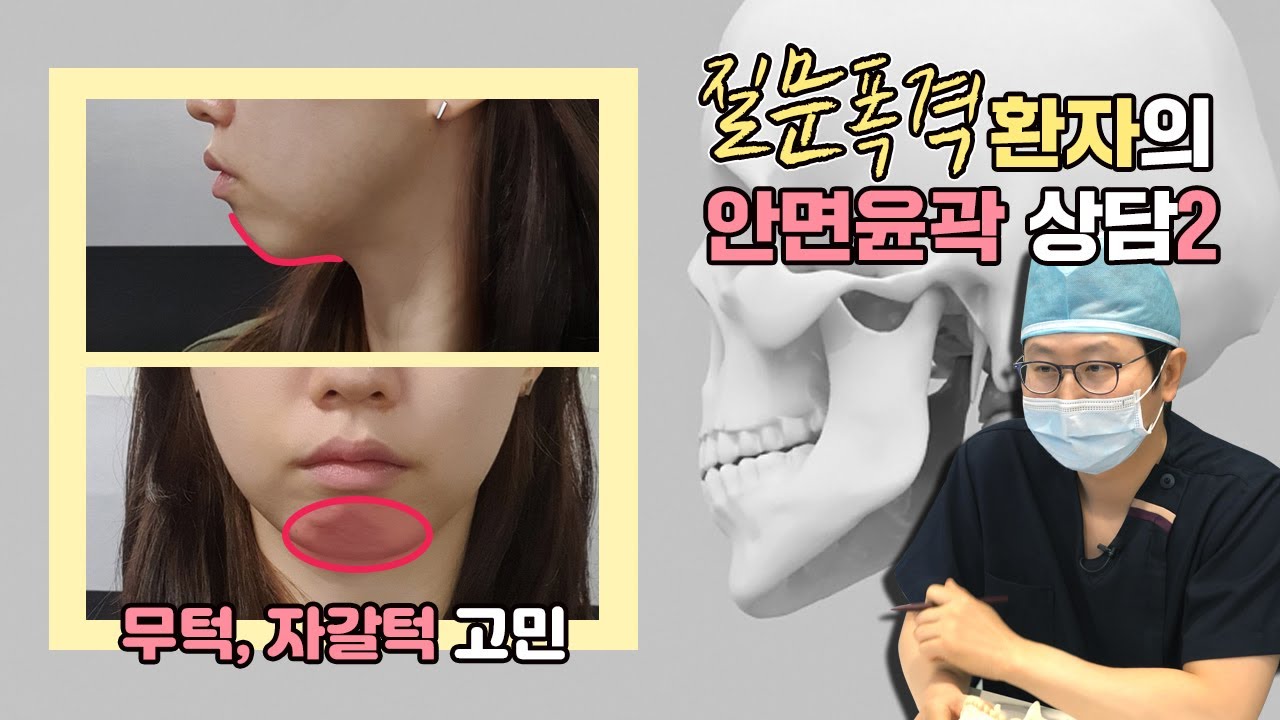
A Patient Concerned About a Receding Chin and a Cobblestone Chin Fires Off Questions: Consultation Video Part 2 — YouTube video thumbnail
A Patient Concerned About a Receding Chin and a Cobblestone Chin Fires Off Questions: Consultation Video Part 2
Mini V-Line! What Are the Pros and Cons? — YouTube video thumbnail
Mini V-Line! What Are the Pros and Cons?
1 / 5

This links to a video on the Face Plus Plastic Surgery YouTube channel. View All FacePlus TV

Dr. Park Jung Keun
Dr. Park Jung Keun · Plastic Surgery Specialist, PhD in Medicine

He personally consults on and performs facial aging treatments such as facelift, droopy eyelid surgery, and thread lift. The doctor personally sees you from consultation through recovery.

2004 Plastic Surgery Specialist2013 PhD in Medicine, Seoul National UniversityVice President, Korean Association of Plastic Surgeons
About the Doctor
Treatment by Dr. Park Jung Keun
Other pages in this menu
Consultation & Booking

We begin by looking together, through thorough consultation, at whether surgery is needed

Facelift, droopy eyelid surgery, and thread lift: Dr. Park Jung Keun personally checks every stage, from consultation to recovery. Please schedule by phone or KakaoTalk, or leave a consultation request form.